How modern sandwich delivery maintains food safety, temperature integrity, and freshness from kitchen to doorstep — a complete look at packaging science and handling protocols.
Food handling during delivery is one of the most technically demanding aspects of the urban sandwich delivery chain. Unlike restaurant dining, where food travels a few feet from kitchen to table, delivery involves extended transit windows, variable temperatures, and physical movement — all of which accelerate food quality degradation if not properly managed.
The challenge is multi-dimensional. Temperature must be controlled to prevent bacterial growth on proteins and dairy. Structural integrity must be maintained so ingredients don't shift, compress, or become soggy. Contamination must be prevented throughout every touchpoint in the delivery process. And the entire system must function reliably at scale — across thousands of simultaneous deliveries in a single city.
Understanding how professional delivery operations meet these challenges reveals why food handling standards have become a critical differentiator in the urban delivery industry.
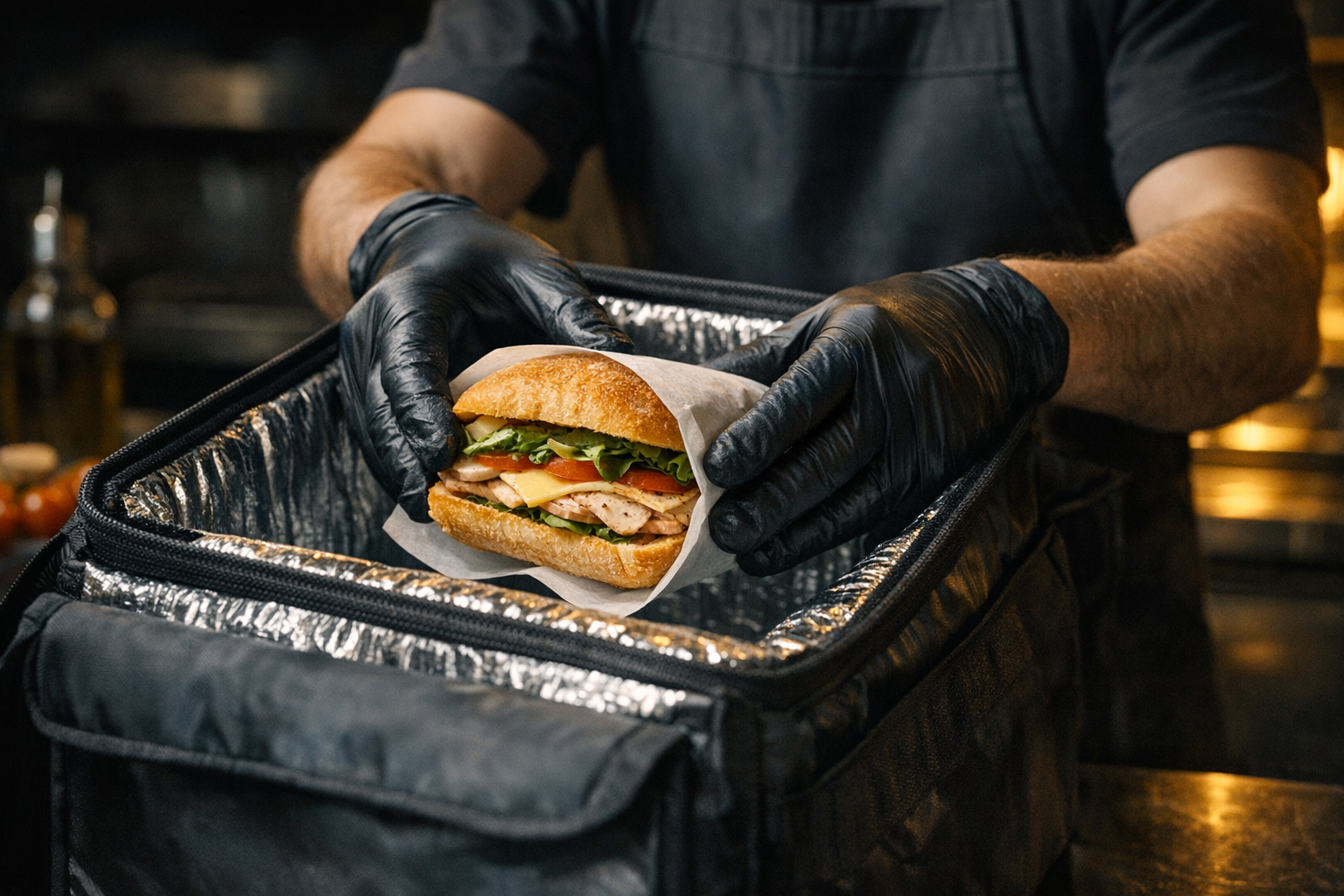
Modern food delivery bags use multi-layer insulation systems — typically an outer nylon or polyester shell, a middle layer of closed-cell foam or reflective foil, and an inner food-contact surface. This layered approach creates a thermal barrier that can maintain internal bag temperature within 5°F of the food's initial temperature for up to 45 minutes.
Higher-end insulated bags used by professional courier fleets incorporate phase-change materials (PCM) — substances that absorb heat energy as they change state, providing extended temperature stability beyond what passive insulation alone can achieve.
The immediate packaging around a sandwich is the first line of defense against moisture transfer, structural collapse, and contamination. Standard wax paper wrapping creates a moisture barrier while allowing slight breathability — preventing the steam condensation that causes bread to become soggy.
More advanced operations use dual-layer wrapping: an inner layer of food-grade parchment that absorbs minor moisture and an outer layer of foil or coated paper that reflects ambient heat and maintains structural shape through the delivery journey.
Tamper-evident packaging has become standard practice in professional sandwich delivery operations. These systems — which include sealed bags, sticker seals that tear irreversibly when opened, and heat-sealed compartments — serve both food safety and customer confidence purposes.
When a tamper-evident seal is intact at delivery, it confirms that no unauthorized access to the food occurred between the time it left the restaurant and arrived at the customer's door. This is particularly important for deliveries involving contactless drop-off, where the courier and customer do not interact directly.
| Material | Primary Function | Thermal Performance | Typical Use Case |
|---|---|---|---|
| Closed-Cell Foam | Thermal insulation, shock absorption | Excellent (up to 45 min) | Insulated delivery bags |
| Reflective Foil Liner | Radiant heat reflection | Good (up to 30 min) | Bag inner lining, wrap layer |
| Wax Paper | Moisture barrier, breathability | Minimal | Direct sandwich wrap |
| Food-Grade Parchment | Moisture absorption, non-stick | Minimal | Inner sandwich wrap |
| Corrugated Cardboard | Structural support, secondary insulation | Moderate (up to 20 min) | Outer box for multi-item orders |
| Phase-Change Material (PCM) | Extended temperature stabilization | Superior (up to 90 min) | Premium delivery systems |
Freshness during sandwich delivery is not a single variable — it is the product of several simultaneous preservation mechanisms working in concert. Temperature management is the most critical of these. The U.S. Food and Drug Administration defines the "temperature danger zone" for perishable foods as between 40°F and 140°F — the range in which bacterial growth accelerates most rapidly.
Professional delivery operations are designed to keep food either above 140°F (for hot items) or below 40°F (for cold items) throughout the entire transit window. In practice, sandwich delivery almost always involves keeping food in the warm-but-safe range of 140°F to 165°F, as sandwiches are typically served warm or at room temperature rather than piping hot.
Beyond temperature, freshness preservation involves managing moisture (soggy bread is one of the top customer complaints in delivery), preventing ingredient separation, and ensuring that volatile aromatics — the smells and flavors that signal fresh food — are retained within the packaging until the moment of opening.
Couriers verify that their insulated delivery bag is clean, dry, and free of odors before accepting any order. Contaminated bags are a leading source of food quality complaints and are replaced immediately when identified.
Sandwiches are loaded flat or in a designated upright position to prevent ingredient shifting. Heavier items are always placed at the bottom; sauces and condiments are secured separately to prevent spillage onto the primary order.
Insulated bags must be fully closed and sealed before the courier departs. Open bags — even partially — allow thermal exchange with ambient air, rapidly accelerating temperature loss and increasing the risk of airborne contamination.
During transit, couriers are trained to keep delivery bags level and stable. For cyclists and scooter riders, this means securing the bag against the body or in a purpose-built carrier rather than hanging it from handlebars, which introduces significant vertical oscillation.
Every minute spent idle — waiting for a building elevator, standing at a crosswalk, or holding an order while receiving additional dispatch assignments — contributes to temperature decline. Well-trained couriers prioritize movement efficiency to minimize unnecessary idle time.
The final handoff involves confirming the order identity, handing the bag directly to the recipient or placing it in a designated safe drop location, and obtaining digital confirmation. Contactless delivery — leaving the order at the door — has become the dominant handoff method in most U.S. urban markets since 2020.
The U.S. Food and Drug Administration establishes baseline food safety requirements that apply throughout the delivery chain. The Food Safety Modernization Act (FSMA) emphasizes preventive controls — requiring operators to identify hazards and implement safeguards before problems occur, rather than responding reactively.
Municipal health departments across the U.S. enforce local food handling ordinances that can be stricter than federal minimums. Cities like New York and Chicago have specific regulations governing temperature control during food transport, courier hygiene requirements, and the type of vehicles permitted to carry food commercially.
Major delivery platforms impose their own food handling standards on top of regulatory requirements. These internal standards typically include courier training programs, bag cleanliness audits, periodic delivery quality assessments, and customer feedback monitoring — all aimed at maintaining consistent quality across their networks.
Effective food handling in sandwich delivery is not a single action — it is a continuous chain of practices that begins the moment ingredients are prepared and ends at the customer's door. Every link in that chain — packaging selection, courier training, thermal management, and handoff protocols — contributes to the final quality the customer experiences. Weak links anywhere in that chain will degrade the result, regardless of how well other elements perform.